KidWind

STEM Meets Wind Energy

A standards-based, cloud-based virtual modeling STEM application that guides students through an engaging, realistic wind turbine development process capped by a very cool siting challenge and simulation -- all before building their actual wind turbines.

A 3-D model is literally developed in minutes! The simplicity of the modeling process puts focus where it belongs - learning the critically important science, technology, engineering and math (STEM) that lives just below the surface. And it's completely web-based ... how cool is that? Then, "connecting the virtual to the physical", students can construct wind turbine blades or output STL files to print their wind turbine blades on a 3D printer, and then assemble their wind turbines.

For pricing information please contact customercare@whiteboxlearning.com.
Click here for a Free Trial

KidWind

How it Works

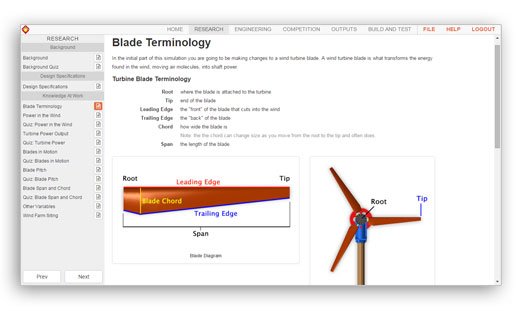
What's the secret to producing more wind energy? It's not magic or luck ... it's science. In this section, your students will find all the theory they need, as well as plenty of activities and tools to put it to action. Plenty of tutorials will ensure that they are well prepared for the remaining sections.
KidWind blade terminology page explaining wind turbine blade parts with labeled diagram showing root, leading edge, middle chord, trailing edge, span, and tip. Includes 3D visualization of assembled blade with root in orange and blade in blue

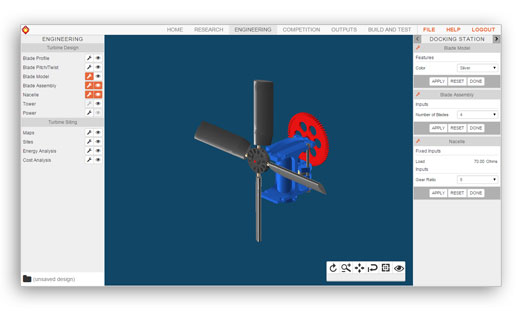
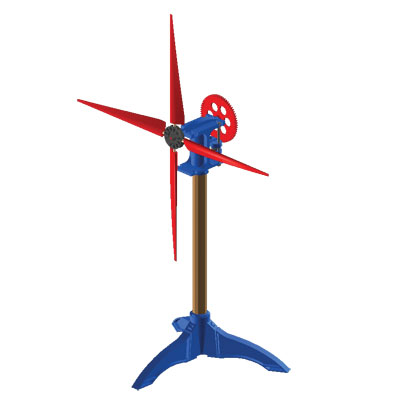
Engineers know their science -- that's for sure. But they also have great tools to help them visualize their design in 3D. In this section, your students will use our custom, built-in CAD system to create 3D models on screen and quickly design different turbine blades
KidWind 3D engineering workspace displaying assembled wind turbine model with three blades in gray and blue, red hub assembly, and brown tower. Left sidebar shows design tools, right panel shows docking station controls

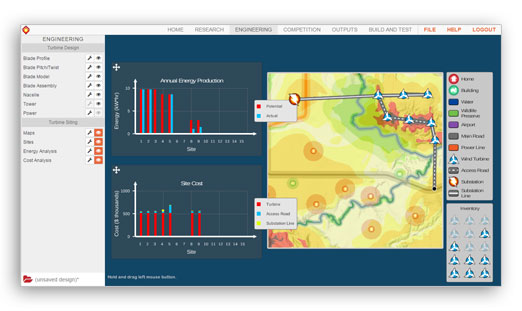
In this section, your students work with a number of built-in tools to see how well their design stands up to the scientific principles presented in the Research section. This stuff is really neat, but it won't make much sense if they haven't completed their Research!
KidWind energy analysis dashboard showing actual energy production and slice cost bar charts over time, alongside topographical terrain map with colored elevation zones, wind patterns, and legend indicating major city, walkway, resource locations, and various land features

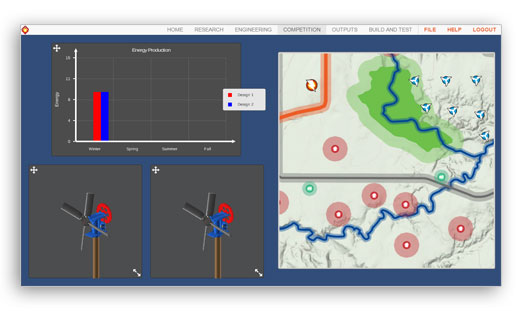
Ready for some fun? In the Siting Challenge, your students compete in a year-long (condensed to about 30 seconds) wind production challenge -- virtually.
KidWind competition view comparing two wind turbines with bar charts showing actual energy production and slice cost performance over time. Topographical map displays both turbines' locations with colored elevation zones, wind patterns, and legend indicating major city, walkway, resource locations, and various terrain features

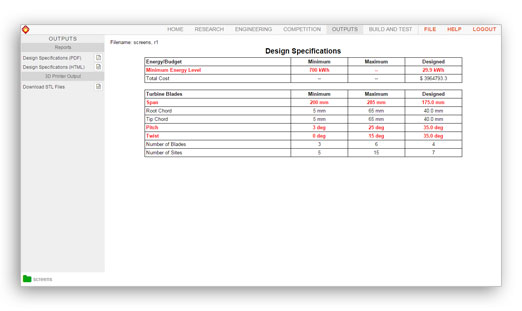
When your students have completed their design, they can construct their wind turbine blades, or, if you have a 3D printer, they'll need an STL file. These items, along with a Design Specification report, can be found in the Outputs section.
KidWind design specifications table showing turbine requirements including energy budget (minimum 15 kWh, maximum blank, designed 15.2 kWh) and further blade specifications with minimum, maximum, and designed values for blade chord, tip chord, twist, taper, number of blades, and number of slats

Benefits

Teacher-Directed Curriculum
The learning system puts teachers in control. Teachers can adjust the content level to meet the varied learning needs of Middle and High School students. Achievement and performance reports help teachers guide student learning.
Standards-based, STEM Knowledge
The application encompasses a high quality standards-based curriculum that enhances the development of fundamental science, technology, engineering, and math (STEM) knowledge.
Comprehensive Suite of Tools
The system contains a fully integrated suite of CAD, analysis, and content delivery tools - all within a common, easy-to-use interface.
Time, Focus, and Confidence
Students have time to focus on making theory actionable. This enables learning, and ultimately yields confidence.
Exciting Web 2.0 Interface
Because the system is web-based, it's accessible from anywhere. It's also built with the most advanced web-based tools available. This provides teachers with the flexibility they deserve, and students with the "wow factor" they expect.

System Requirements

KidWind is a web-based product. All modern browsers are supported, including:

  • Microsoft Edge: version 18 and higher
  • Google Chrome: version 61 and higher
  • Firefox: version 60 and higher
  • Safari: version 12.1 and higher

The application may still work in older browser versions but support for those is not guaranteed.

We recommend using a computer with a minimum screen resolution of 1280 x 720. We do not recommend iPads as screen size can be issue when sketching and displaying 3d models.